yootle Clearer reality. Better returns.

Company Reality
from the People Who Know It Best

Yootle gives employees a protected way to give their employers a candid look at how the company is doing: for its people, its customers, its strategy, its execution, and what it delivers.

Built for maximum defense of employee feedback, Yootle puts protection into its architecture and design. Identity is kept separate from answer records. Employers receive aggregate findings, never individual answers. Those protections make room for employees to speak candidly.

Invited to participate? Start with the link your organization sent you.

How it works
Participation & findings

How it works

Employees share what they observe.

If your organization invites you to participate, you answer structured questions about your experience at work. Participation is voluntary. Use a personal device and connection, away from work accounts, machines, and networks.

Yootle brings the answers together.

At least 30 responses are pooled before reporting results. Employers receive aggregate findings, never individual answers.

Employees get the findings, too.

All eligible employees receive the same findings within 24 hours of release to company management, whether or not they participated. The findings reflect the people who answered.

The Yootle Difference

Built to make room for candor

Useful feedback depends on people being able to speak candidly. Yootle keeps identity separate from answer records and requires employers to commit to non-retribution when they sign up.

Explore The Yootle Difference
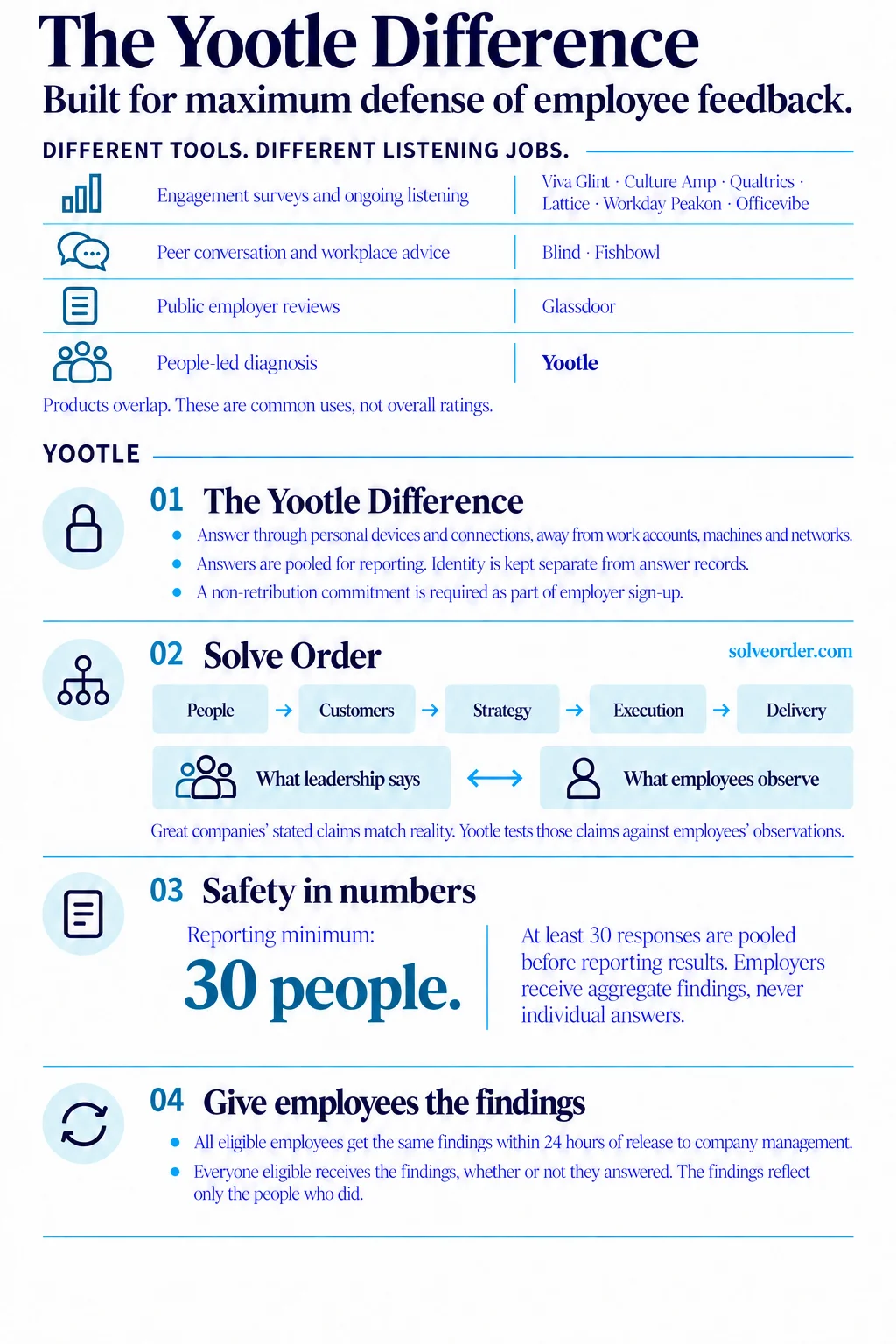
The Yootle Difference infographic (opens full size). Different tools do different listening jobs: engagement surveys and ongoing listening (Viva Glint, Culture Amp, Qualtrics, Lattice, Workday Peakon, Officevibe); peer conversation and workplace advice (Blind, Fishbowl); public employer reviews (Glassdoor); people-led diagnosis (Yootle). Products overlap; these are common uses, not overall ratings. Yootle: 1, answer through personal devices and connections, away from work accounts, machines and networks; answers are pooled for reporting and identity is kept separate from answer records; a non-retribution commitment is required as part of employer sign-up. 2, Solve Order: people, customers, strategy, execution, delivery; Yootle tests what leadership says against what employees observe. 3, safety in numbers: reporting minimum of 30 people; employers receive aggregate findings, never individual answers. 4, all eligible employees get the same findings within 24 hours of release to company management, whether or not they answered; the findings reflect only the people who did.
Solve Order

The argument behind the diagnosis

The Solve Order paper argues that companies improve their odds of success by giving priority to the people and conditions that produce their results. Employees’ experience is a starting point for understanding where those foundations are strong and where they need attention.

Think of it as reality-as-a-service: a way to ground the company’s understanding in what its employees observe.

Revenue, profit, EBITDA, customer satisfaction, and other performance measures tell a company how it is doing. Solve Order calls these results WHERE. Its hypothesis directs attention to five connected areas that help produce those results, in this priority order:

  1. WHOPut your people first.
  2. WHOMKnow your customers.
  3. WHYSet a clear direction.
  4. HOWMake good work repeatable.
  5. WHATDeliver products and services that fit.
The Solve Order skwedge, with WHO at the foundation, then WHOM, WHY, HOW, and WHAT at the top.
People form the foundation.
Each layer supports what comes above it.
Explore Solve Order

Watching the scoreboard does not improve the score. Solve Order proposes the order in which to attend to what produces it. Yootle gathers candid observations from the people doing that work, so the company can examine how those five areas may be affecting its results.

Claims & experience

Does the company’s account match employees’ experience?

Yootle also measures the distance between a company’s stated claims and employees’ experience. These comparisons show where the company’s account of itself is supported by employees’ observations, and where the two diverge. Knowing there is a gap gives the company something concrete to investigate and address.

Together, the five-area assessment and these comparisons give the company a starting point for diagnosis: what appears to be working, where experiences differ, and what deserves closer investigation.

Invited to participate?

Start with the invitation your organization sent you. It contains the link for your assessment.